


Passing
Passing of Her Royal Highness
Princess Abigail Kinoiki Kekaulike Kawānanakoa
He aliʻi i hānau ʻia no ke kuleana — a he aliʻi i hoʻi i ke aloha.
“A chief born for responsibility — and a chief who returned in love.”
On Sunday, December 11, 2022, Her Royal Highness Princess Abigail Kinoiki Kekaulike Kawānanakoa heir to the Hawaiian throne and senior descendant of the Kalākaua Dynasty passed from this world into the embrace of her ancestors. She was 96 years old.
The announcement of her passing was not simply made, it was proclaimed in keeping with the sacred traditions of the aliʻi. On the grounds of ʻIolani Palace, the seat of her royal lineage and the symbolic heart of the Hawaiian Kingdom, a formal declaration was delivered in ʻōlelo Hawaiʻi, the language of her ancestors.
Two caretakers of Hawaiian cultural and royal institutions carried out this solemn duty: Paula Akana, Executive Director of ʻIolani Palace, and Hailama Farden, leader of Hale O Nā Aliʻi, the royal society of which the Princess and her forebears were prominent members.
In silence, they descended the grand staircase of the Palace, a place where her grandmother once held court and where the echoes of monarchy remain alive in stone and memory. Together, they walked the royal drive to the front gates.
There, they paused.
And in the ancestral tongue, they delivered the news to the world: the aliʻi had returned to the heavens.
When their words were complete, they turned and ascended the path once more — a ceremonial arc of descent and return, befitting the moment. No translation was provided.
The Princess’s Casket
In the tradition of aliʻi resting places where every element holds meaning and every material speaks of lineage Abigail’s casket was itself a tribute to ancestry, nature, and the timeless dignity of Hawaiian royal legacy.
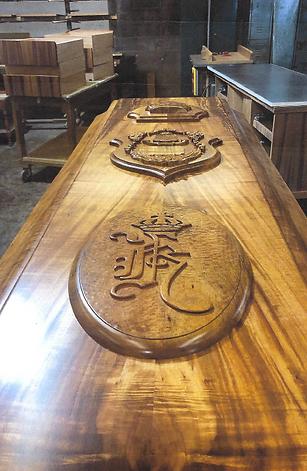
Crafted by hand, the casket was created by Martin & MacArthur, renowned artisans whose legacy echoes that of the monarchs whose furniture still adorns ʻIolani Palace. It was formed from a single 165-year-old koa tree a native elder of Hawai‘i Island, once rooted in the Pu‘u ʻŌʻō region between Mauna Loa and the Waiākea Forest Reserve. This tree had long provided shelter to generations of native nēnē birds, standing strong against the winds and rains of the upland slopes.
Now, that same tree enfolds the last living royal of the Hawaiian Kingdom.
Emblems of Royal Identity
The casket’s surface, shaped from shimmering curly koa, bears three carved crests:
-
The Crown of Hawaiʻi, symbol of the sovereign line
-
The Coat of Arms, bearing the standards of the Hawaiian Kingdom
-
The personal crest of the Princess herself the “Crown K”, a monogram of nobility, lineage, and legacy
These emblems were not merely decorations, but carved affirmations of aliʻi identity visible markers of the bloodline she bore and the kuleana she carried.


Nā Hana Lima – The Craftsmen
Guided with care by Michael Tam, President of Martin & MacArthur, the casket was brought to life through the combined mastery of Hawaiʻi’s finest artisans:
-
Simon McKenzie – who discovered and sourced the rare koa with reverence
-
Guy Leslie – who built the structure with ancestral precision
-
Mel Pascual – who carved the royal emblems with devotion
-
Michael Schwenke – who designed and constructed the unique sloped lid, a nod to classical forms of Hawaiian ceremonial design
-
Stacy Hanohano – who installed the mechanical elements and created the rich silk interior that cradled the Princess in her final repose
Together, their work formed not merely a vessel, but a statement of love and honor a resting place worthy of the highest of aliʻi.
Lying in State at ʻIolani Palace
On Sunday, January 22, 2023, the Throne Room of ʻIolani Palace was once again consecrated as a sacred chamber of remembrance and reverence. For only the twelfth time in Hawaiian history, a beloved aliʻi lay in state within its regal walls and for the first time in generations, the spirit of Hawaiian royalty returned home to rest.
Abigail was carried across the threshold not by decree, but by aloha through chant, wailing, and solemn procession befitting her lineage.
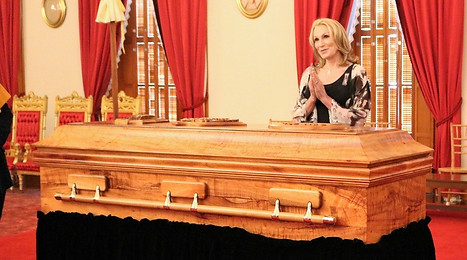
The Death Wail and Procession of Her Royal Highness Princess Abigail Kinoiki Kekaulike Kawānanakoa
In the twilight moments of an aliʻi’s journey from this realm to the next, tradition gives us one of the most profound expressions of collective grief and reverence: the death wail.
In ancient Hawaiʻi, as in the royal courts of Europe, mourning was not a quiet affair. It was an outpouring vocal, spiritual, embodied. For the aliʻi, those born of divine genealogy and bound by sacred kuleana, the passing of a chiefess such as Her Royal Highness Princess Abigail Kinoiki Kekaulike Kawānanakoa demanded nothing less.
The wail, known as kanikau or ue, is not merely crying. It is chanted, sculpted grief—part lamentation, part history, part farewell. The Hawaiian wail holds memory in vibration. It is how sorrow and remembrance take voice.
On the morning of her Lying in State at ʻIolani Palace, that sacred practice lived again.
Hailama Farden, Wailer of the Aliʻi
Few still carry the ancestral practice of wailing. Among them is Hailama Farden; educator, chanter, and kahu mele (keeper of chant) named a Living Treasure of Hawaiʻi in recognition of this kuleana.
For Princess Abigail, Hailama offered his voice.
He had wailed before for aunties, for elders, and for members of the Kawānanakoa line: Edward “Dudie,” Poʻomaikelani, Regina, Edward Jr., and Carol. But this occasion stood apart. As Hailama later reflected, “If Hawaiʻi were still a kingdom, this woman would have been our Queen.”
He began the wail as the hearse approached the ceremonial gates of ʻIolani Palace the Kauikeaouli Gates, named for Kamehameha III. The gates opened. The procession slowed. And the sound of grief, sacred and practiced, moved through the air.
The Structure of a Wail
A traditional Hawaiian death wail follows no fixed script, yet it carries a rhythm understood by those who have learned through lineage and guidance. As Hailama explains, it unfolds in three movements:
-
The First Cry – Grief and Anger
“Why did you leave us?”
“You have abandoned us.”
There is sorrow, but also scolding of the hearse, of the departed, of the fate that has brought this pain. In the voice, you hear the confusion of loss.
-
The Middle – Story and Lineage
“We remember your family and how much we honor them…”
“We recount your many works on our behalf and on behalf of Hawaiʻi…”
Here, the wail becomes biography — the collective memory of the deceased, spoken aloud so that the ancestors may know and the people may remember.
-
The Final Cry – Reconciliation and Release
“Thank you for your time with us.”
“We call upon your ancestors to carry you home.”
It is an offering of peace, an invitation to return to the piko (source), a prayer that the departed may travel safely into the embrace of those who came before.

Hailama Farden stands on King Street in front of ʻIolani Palace as Abigail's motorcade arrives
The Procession and Arrival
At 1:30 p.m., a black hearse bearing her koa casket entered the Palace gates. A small, dignified procession followed along the coral-lined drive. As it passed beneath the swaying palms, Hailama’s voice rose in lament:
He began with lament:
“We came to your house and you were not there.
We have lost you from the world.
The cliffs of the Pali are dark. The waves crash with sorrow.”
Then came memory:
“We remember your lineage.
We honor your story, your many gifts to Hawaiʻi.”
And finally, farewell:
“We thank you for your time with us.
We call upon your ancestors to carry you home.”
As the hearse made its passage to the steps of the Palace, Kumu Manu Boyd began to chant the Princess’s moʻokūʻauhau—her genealogy so that all might hear, name by name, the royal lines to which she now returned.
A specially trained honor guard of law enforcement officers largely from the Sheriff Division and the Honolulu Police Department stepped forward. Their movements were precise and unified, guided by commands spoken only in ʻŌlelo Hawaiʻi. With reverent strength, they lifted the casket onto their shoulders and ascended the very steps once trod by her ancestors, the Kawananākoa family waited at the top of the stairs to welcome her.
Inside, the Throne Room was prepared for vigil. Members of the Royal Societies Hale O Nā Aliʻi, ʻAhahui Kaʻahumanu, the Royal Order of Kamehameha I, and Mamakakaua stood watch in rotation throughout the day, forming a lei of living guardianship around the Princess.
At 2:00 p.m., the Palace gates opened to the public. From across the pae ʻāina, the people of Hawaiʻi came some with flowers, some with tears, and all with reverence. They passed quietly before her, each step a gesture of aloha and gratitude for the woman who, for nearly a century, embodied Hawaiʻi’s royal legacy.
Procession video coming soon
A Chamber of History
By lying in state in the Throne Room, Abigail entered a storied line of aliʻi who had received this sacred honor:
-
Princess Likelike – the first to lie in state in 1887
-
King David Kalākaua, her great-granduncle – 1891
-
Albert Kūnuiākea, son of Kamehameha III – 1903
-
Prince David Kawānanakoa, her grandfather – 1908
-
Prince Jonah Kūhiō Kalanianaʻole – 1922
Though Queen Liliʻuokalani did not lie in state at the Palace, her private funeral was held in the same room in 1917. Her husband, John Owen Dominis, did lie in state in the Throne Room in 1891. The funeral of Prince Edward Keliʻiahonui also took place there after his passing in 1887.
The Throne Room, once the seat of royal diplomacy and ceremony, had become again what it was always meant to be a resting chamber for Hawaiʻi’s highest. As soft oli filled the corridors and the scent of lei lingered in the air, the aliʻi spirit of the Kingdom was, for a moment, wholly present.
The Funeral at Mauna ʻAla
On the morning of January 23, 2023, beneath the quiet canopy of Nuʻuanu, a private funeral service was held for her at Mauna ʻAla, the Royal Mausoleum of Hawaiʻi. This sacred resting place, a wahi kapu revered for generations, received once more a beloved daughter of the Kingdom.
Princess Abigail, in looking at what she wanted in a funeral service, found its best expression as it being “a State funeral without the State.” That meant that Governors (current and a former one or two), the Lt. Governor, the Speaker and Senate President. the Mayor and Council Chair, and the Chief Justice and Probate Judge (both of whom were obligated to decline). It also meant the Hawaiian leadership was there: the Aliʻi Trustees, the Royal Societies, The Office of Hawaiian Affiars, the Hawaiian Directors of Hawaiian Home Lands and of Land and Natural Resources, the Dean of Hawaiian Studies, and the West Oʻahu Chancellor.
The Kawānanakoa Family was there with every part of the family represented, the Maori King and his family, and close family and friends in the Chapel and in tents outside where they could watch it on large screens.
And the funeral was live-streamed so that anyone and everyone could watch it, as you can through the link below along with reading the full transcript of the ceremony.
It was entirely hers on her terms in her way – honored without spectacle and instead with solemnity, without pageantry and instead with deep purpose and dignity.
Watch the Funeral Ceremony
View the Funeral Program – Order of Service
A Burial Among Ancestors
Though her lineage would have permitted interment in the Kalākaua Crypt, the chamber had long since reached capacity. In preparation for this moment, Princess Abigail had made her wishes known. A new tomb designed by Robert Mandich was constructed within the grounds, bearing black galaxy granite to harmonize with the resting places of her royal kin.
The burial itself was very private.
First came the hearse from Oʻahu Cemetery bearing her one last time. Waiting was her Honor Guard who carried her to the tomb and lovingly lowered her casket to the floor and placing it an exact east-west position with her feet walking into the west based on the advice of kūpuna. They then placed a koa box containing their ceremonial white gloves next to her casket and left the grounds.
Next, Hale O Nā Aliʻi O Hawaiʻi processed on to the grounds and said their farewells with tradition and protocol. Part of their group were two of Abigailʻs young cousins.
Finally, with just a very few present, Manu Boyd recited her lineage and Nettie Tiffany offering one final blessing, Veronica placed lei and her feather capes on the casket and bid her private farewell.
Those present then pushed the tomb cap halves together, with the sound of its final closing moment going straight through everyone. The group included one of those cousins, Kaʻeokulani Kawānanakoa on behalf of the family.
The ceremony honored both tradition and her singular life: a royal who bridged generations, and a cultural steward who chose continuity over crown.
In this return to Mauna ʻAla the final resting place of King Kalākaua, Queen Kapiʻolani, Queen Emma, and many others Princess Abigail completed the journey of her lineage. From the courts of aliʻi to the halls of advocacy, she had walked with her ancestors at her side. And now, she joined them in the silence of sacred ground, sealed with oli, mele, and aloha.
Her Tomb at Mauna ʻAla
On December 17, 2012, Abigail formally petitioned the State Board of Land and Natural Resources (BLNR) for permission to construct a tomb within the sacred grounds of Mauna ʻAla, the Royal Mausoleum of Hawaiʻi. There was significant opposition to that request. In order to make an appropriate decision, BLNR Chair William Aila asked the Kahu of Mauna ʻAla, William (Bill) Kaiheʻekai Maioho, to share his manaʻo with the Board. Maioho who had a sometimes contentious relationship with Abigail appeared before the Board and brought the discussion to its most essential point. He stated plainly that she had the kōkō, the bloodline, to be buried there, and that if she wished to be there, she should be. Based largely upon that statement, the BLNR approved her request in 2013, marking the first time in generations that a new royal tomb would be placed upon these consecrated grounds.
Though by genealogical right she could have been interred within the Kalākaua Crypt alongside her royal relatives including King Kalākaua and Queen Kapiʻolani, the crypt had long since reached capacity. With the lineage full, the path forward required both vision and reverence.

A Tomb of Intention and Design
To fulfill this responsibility, Princess Abigail turned to architect Robert Mandich, who worked closely with her to bring her wishes into form. Every aspect of the tomb from its materials to its placement reflected her intent: to rest in sacred symmetry with her royal ancestors, while honoring the continuity of her line.
The tomb itself, constructed of Black Galaxy granite, was selected for both its strength and symbolic depth. It mirrors the basaltic darkness of the Kalākaua Crypt nearby, establishing visual harmony while standing distinct in form. Its design was inspired by the Wyllie Tomb, one of the most architecturally refined memorials at Mauna ʻAla, yet Abigail’s resting place remains modest in size but resolute.
Positioned opposite the Wyllie Tomb, her monument now forms a quiet axis on the grounds: a line drawn between legacy and renewal.
Story of tomb model coming soon
The Capes of Her Royal Highness Princess Abigail Kinoiki Kekaulike Kawānanakoa
In the traditions of the Hawaiian Kingdom, the wearing of an ʻahu aliʻi — a chief’s cape — was a mark not only of rank, but of kuleana. These capes, painstakingly created over years or even decades, were sacred garments bestowed upon those who held both the blood and the burden of leadership.
What Is an ʻAhu?
The Hawaiian term ʻahu aliʻi refers to the feathered capes worn by royalty and high-ranking chiefs and chiefesses. Longer versions, often reserved for the highest aliʻi were known as ʻahuʻula, cloaks that cascaded over the shoulders and symbolized the weight of chiefly responsibility.
Traditionally, these garments were woven with the feathers of endemic birds, many of which are now extinct. Their creation required deep knowledge of materials, colors, and ritual. The red and yellow tones most often seen in aliʻi garments were not merely aesthetic they were declarations of kapu rank and lineage. Even today, these colors evoke the sacred: red for high birth, yellow for divine ancestry.
While feather capes are the most well-known, some ʻahu were crafted from velvet a favored material in the 19th century, prized for its regal weight and luminous sheen.
The Two Capes of Princess Abigail
Abigail possessed two capes each with its own story, each representing a different chapter in her life of service.
-
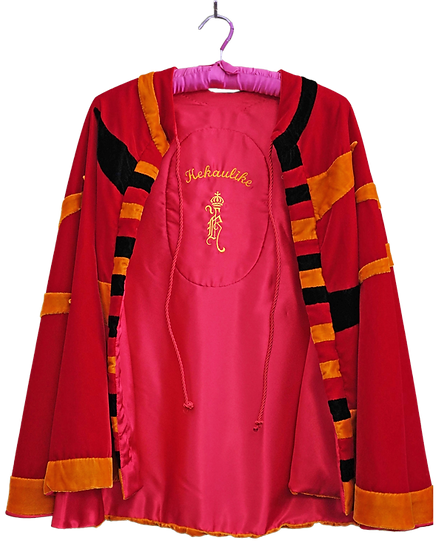
I Ku Wohi – The Velvet Cape of Hale O Nā Aliʻi
Identical to a cape worn by her mother, Princess Lydia Liliʻuokalani Kawānanakoa Morris, this deep red, yellow, and black velvet cape was the physical symbol of her rank as I Ku Wohi, Third Regent of the Royal Benevolent Society Hale O Nā Aliʻi O Hawaiʻi.
The cape was more than ceremonial regalia; it was an emblem of her leadership within one of Hawaiʻi’s four royal societies, an institution dedicated to preserving the dignity, protocol, and historical truth of the monarchy.
-
Kekaulikewahine – The Feathered Cape
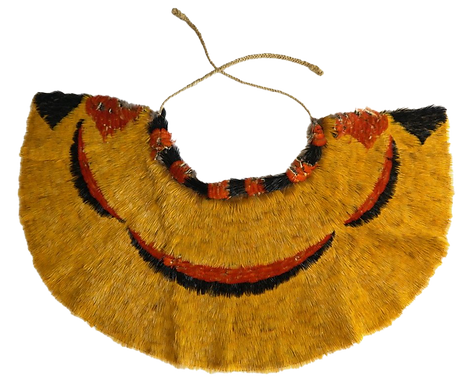
Created shortly after her passing by Hawaiian featherwork master Rick San Nicholas, this ʻahu liʻi was named Kekaulikewahine in honor of Abigail’s ancestral namesake. With red, black, and yellow crescents upon a golden field, the cape embodied the triple lineage of Kalākaua, Keawe, and Hulu lines of light, lava, and sky.
Its feathers speak in silence: of her house, her humility, and her heritage. The Manu-shaped figures represent the aliʻi’s ascent, the protective triangles her open-hearted approach to leadership, and the black field below a nod to the land fertile and eternal.
I Ku Wohi – The Velvet Cape of Hale O Nā Aliʻi O Hawaiʻi
Presented by the leadership of Hale O Nā Aliʻi O Hawaiʻi, the I Ku Wohi cape is a velvet garment of deep red, yellow, and black that formally signified Princess Abigail’s role as Third Regent. These rich hues, long associated with Hawaiʻi’s aliʻi, affirm rank, responsibility, and continuity, with each stitch standing as an act of remembrance and respect.
This cape was not merely worn; it was revered. For Princess Abigail, it embodied her solemn commitment to uphold the values of Hale O Nā Aliʻi and to safeguard the spiritual and ceremonial integrity entrusted to her through lineage. It served as a tangible expression of kuleana, carried with humility and quiet authority.
As part of her enduring legacy, the I Ku Wohi cape was gifted to ʻIolani Palace, where it may be displayed in quiet reverence. There, it stands in silence, bearing witness to the life of a chiefess who carried her rank with dignity, devotion, and unwavering respect for her ancestors and her people.
A Legacy of Leadership Within the Society
Princess Abigail Wahiʻikaʻahuʻula Campbell Kawānanakoa, the matriarch who hānai-adopted her granddaughter Abigail — held a place of prominence in Hale O Nā Aliʻi. So too did her daughter, Princess Lydia Liliʻuokalani Kawānanakoa Morris, who bore the rank of I Ku Wohi, or Third Regent.
Upon her mother’s passing, that rank and its accompanying responsibilities were formally conferred upon Abigail. This was more than inheritance — it was continuation. A recognition by the society of the Princess’s standing, her service, and her fidelity to aliʻi protocol.
Kekaulikewahine – The Final Feathered Cape of a Princess
Throughout her life, Abigail had admired the artistry and mana of the traditional aliʻi feather capes, symbols of divine protection, chiefly power, and sacred continuity. While she was gifted one ʻahu liʻi from Hale O Nā Aliʻi in recognition of her role as I Ku Wohi, she long desired a feathered cape worthy of her royal heritage, one that would accompany her in her final journey.
That desire was fulfilled in the days following her passing.
A Work of Lineal Devotion
Master Hawaiian featherwork artist Rick San Nicolas, whose expertise in traditional ʻahuʻula is matched only by his reverence for their meaning, was entrusted with the creation of a final cape for the Princess. The result was a masterpiece known as Kekaulikewahine a name that honors the Princess’s ancestral line and her namesake, Kekaulike, the fifth great-grandmother of Abigail and a direct descendant of King Keawe II and Chief Kauhiokaka.
Rick always displays his featherwork at the Merrie Monarch Hawaiian Arts and Craft Fair and he and Abigail had spoken frequently on featherwork which gave him a good sense of what was meaningful to her.
Sacred Colors, Sacred Symbols
Set against a brilliant yellow background, the royal color of the aliʻi, the cape features elements in scarlet and black, each chosen with intent and layered meaning:
-
The Three Crescents represent the Houses of Kalākaua, Keawe, and Hulu — genealogical lines that converge within the Princess and form the foundation of her claim and kuleana.
-
The Scarlet crescents evoke glowing lava as seen on the wings of the sacred Manu, birds of highest flight and highest standard symbolic of the Princess’s soaring influence and elevation among aliʻi.
-
The Black Field beneath reflects new land birthed from lava, a metaphor for rebirth, continuity, and the enduring nature of Hawaiian sovereignty.
-
The Manu Form represents the aliʻi ability to rise spiritually and in service to the heavens, bringing guidance and protection to those below.
-
The Triangles across the design offer a final layer of symbolism: guardianship, approachability, and the Princess’s famously open heart.
A Cape of Tribute, Not for Wearing
Kekaulikewahine was not created for the living Princess to wear it was crafted as a sacred adornment for her final resting journey, a tribute woven not of feathers alone, but of lineage, honor, and return.
This ʻahu is more than an object it is a ceremonial embodiment of the aliʻi line and the kingdom she carried within her. In death, as in life, Princess Abigail was cloaked in her ancestors.
He Koa Aliʻi: The Story of the Kawānanakoa Honor Guard
The Royal Watch of the Last Princess.
A Ceremony Etched in Memory
One of the most poignant moments in the ceremonies honoring Her Royal Highness Princess Abigail Kinoiki Kekaulike Kawānanakoa came as her koa casket was lifted in a single, fluid motion by an honor guard of state and county officers. With commands called in ʻŌlelo Hawaiʻi, they carried her on their shoulders up the grand staircase of ʻIolani Palace a gesture not witnessed in generations.
As one officer quietly observed, “You could feel the weight wasn’t just the casket. It was history.”

The Call to Kuleana
When the decision was made for the Princess to lie in state at ʻIolani Palace, representatives from Hawaiʻi’s law enforcement community were called into a coordination meeting. The initial agenda: traffic control, security, and ceremonial logistics. Then came the unexpected question:
“Would you be willing to serve as her Honor Guard?”
“We were taken aback,” said Lt. David Kauahi of HPD. “None of us expected that. Some of the guys just looked at each other in silence.”
Michael Oakland of the Sheriff’s Division added, “There was a kind of reverent pause. We knew what was being asked. It wasn’t just about duty—it was about honoring lineage.”
Kauahi nodded. “For many of us, our families have been here since the Kingdom. This was… our Princess.”
They said yes.
Forging the Guard
Koa Dobrowolsky, First Deputy Sheriff, helped form the team. He wanted a unit not only strong enough to carry the casket but with the cultural understanding to carry the moment.
“They had to handle more than weight,” Koa said. “They had to carry a legacy.”
The team included members from HPD, the Sheriff Division, DLNR/DOCARE, and staff from ʻIolani Palace. Their practice sessions began at the Palace steps, with an empty mahogany casket lent by Borthwick Mortuary.
“The first few lifts were rough,” admitted Officer Cameron Tuitele. “We were stiff, out of sync.”
It changed when they moved training to the U.S. Air Force Honor Guard Training Facility. There, drills became more refined.
“Something clicked,” said Officer Ben Lloyd. “It stopped being just practice. We became a unit.”
Choosing to Shoulder the Past
The team was presented with options: use the rolling platform (“truck”), carry by side handles, or lift her to their shoulders.
“We saw the footage of Queen Elizabeth’s funeral,” Kauahi recalled. “And we thought—if they can carry their queen, we will carry ours.”
They chose the hardest path.
When they practiced with the actual koa casket, they were shocked.
“It was double the weight of the practice one,” said Officer Eric Castro. “We all felt it in our bones. But none of us flinched.”
To make the carry possible, Martin & MacArthur built a custom bottom panel. Still, the weight dug into their shoulders.
“Painful? Sure,” said Del Toro. “But worth it.”
The Commands in Hawaiian
All commands for the ceremony were issued in ʻŌlelo Hawaiʻi.
“There were no existing records,” Koa explained. “So we worked with language experts, Paula Akana from the Palace, and the Royal Guard to construct them.”
Officer Jason Lee, one of the detail members, said: “It was powerful to hear those words. It brought the Kingdom into that moment.”
The Lifting of the Princess
The unit lifted her with a single motion and ascended the steps of ʻIolani Palace.
“It felt like time slowed down “ said Officer Henry Haina. “You could hear the wailing, the oli. It was… sacred.”
The weight of the casket was extraordinary to begin with and as they mounted the stairs, it felt heaviest for those at the back where the strongest men had been placed.
Kauahi, who was at the very back, whispered to her “we will not let you fall Princess” all the way to the top.
As they reached the top and were greeted by the Kawānanakoa Family, she was carried into the Throne Room.
The Journey to Mauna ʻAla
After the ceremony was over, they took her out of the Palace and down the mauka steps to the waiting hearse that would take her to Mauna ʻAla.
At Mauna ʻAla, they carried her into the Chapel where she was laid on the altar for her funeral services the next day.
In keeping with long standing custom, the Honor Guard removed their white gloves and laid them on the casket where they remained during the overnight vigil by members of the Royal Societies.
The next morning those gloves were collected and stored.
A Private Burial, A Final Gesture
After her funeral service, she had been taken back to ʻOahu Cemetery to await the completion of her tomb.
When the tomb was ready, the Honor Guard met her at Mauna ʻAla for the final journey, They carried her from the hearse to the tomb and then placed her casket on the floor of her tomb. And then in accordance with her wishes, they placed her in an exact East-West alignment,
“She had planned it all” said Oakland. “Even the direction she would face.”
And as Kauahi noted with great reverence:
“She was lighter that day. Almost like she had already let go.”
In a final act of honor, the gloves which had been placed on her casket after the lying-in-state had been placed in a koa box made of the same wood block that had been used to make her her casket. That box was then placed by the Guard next to her casket to acknowledge their service and aloha to her for eternity

Members of the Kawānanakoa Honor Guard
Escort and Bearers
-
Lt. Michael Oakland (Sheriff Division)
-
Chief Deputy Lanikoa Dobrowolsky (Commander, Sheriff Division)
-
Lt. David Kauahi (Rear Escort, HPD)
-
Sgt. Adrian Kanoa (Sheriff Division)
-
Deputy Scott Namuo (Sheriff Division)
-
Sgt. Daniel Del Toro (HPD)
-
Officer Cameron Tuitele (HPD)
-
Officer Henry Haina (DOCARE)
-
Officer Errol Kane (DOCARE)
-
Officer Bo Kanekoa (ʻIolani Palace)
-
Cpl. Benjamin Lloyd (HPD)
-
Officer Eric Castro (HPD)
Honor Detail – Throne Room
-
Deputy Deven English (Sheriff Division)
-
Deputy Andre Jackson (Sheriff Division)
-
Officer Preston Kamauʻu (DOCARE)
-
Officer Jasion Lee (DOCARE)

Final Words